
loading
Multi-Effect Evaporator: Energy-Saving Concentration & Crystallization Solution 1

Multi-Effect Evaporator: Energy-Saving Concentration & Crystallization Solution

Maximize Energy Efficiency with Multi-Stage Steam Reuse
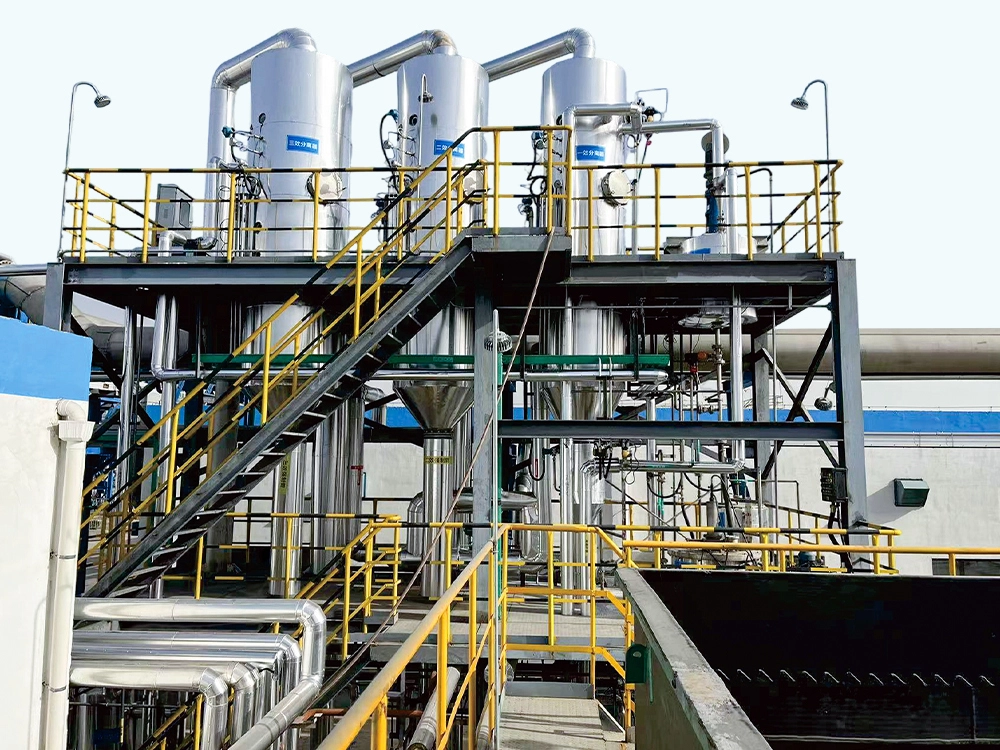
A Multi-Effect Evaporator is a combined system consisting of multiple single-effect evaporators. Its core advantage lies in reusing the waste steam generated by the previous effect as the heating medium for the next effect, significantly reducing energy consumption. Common configurations include double-effect, triple-effect, and even multi-effect evaporation systems. The number of effects should be selected based on specific operating conditions, as more control points lead to greater influencing factors and smaller temperature difference driving force under different impacts.
5.0
design customization

    oops...!

    no product data.

    Go to homepage

    Working Principle: Energy-Saving via Steam Reuse

    In a multi-effect evaporation system, the steam generated by heating the first effect with fresh steam does not enter the condenser directly. Instead, it is reused as the heating medium for the second effect. This principle alone can reduce fresh steam consumption by approximately 50%.

    By repeating this steam reuse principle across multiple effects, fresh steam consumption can be further reduced. The total temperature difference is formed between the maximum heating temperature of the first effect and the minimum boiling temperature of the last effect, which is distributed among each effect. As a result, the temperature difference per effect decreases with the increase in the number of effects.

    To achieve the specified evaporation rate, the heating area must be increased. Preliminary estimates show that the total heating area required for all effects increases proportionally with the number of effects. Consequently, while steam savings gradually diminish, the investment cost rises significantly-making the selection of effect number a key balance between energy efficiency and investment.

    图片 1 (11)

    Product Classification

    Multi-Effect Evaporators are mainly divided into two types, tailored to different material properties and process requirements:

    a10
    Standard Multi-Effect Evaporator
    Composed of multiple single-effect evaporators connected in series, relying on the natural circulation of materials to complete evaporation. It is suitable for materials with good fluidity and low scaling tendency, offering stable performance and simple structure.
    a09
    Forced Circulation Multi-Effect Evaporator
    Based on the standard multi-effect system, multiple forced circulation pumps are added. These pumps increase the flow rate of materials in the evaporation tubes, which improves heat transfer efficiency and enhances evaporation intensity. This type is particularly suitable for materials with high viscosity, easy scaling, or poor heat transfer performance.

    Key Advantages

    recycle (2)
    Significant Energy Savings
    Reuses waste steam as heating medium, drastically reducing fresh steam consumption compared to single-effect evaporators.
    a02
    Flexible Configuration
    Available in double-effect, triple-effect, or multi-effect designs, customizable according to evaporation capacity and energy-saving requirements.
    two
    Strong Adaptability
    Forced circulation type handles high-viscosity, scaling-prone materials; standard type suits general low-difficulty applications.
    heat-wave
    High Processing Efficiency
    Multi-stage evaporation design and enhanced heat transfer (forced circulation type) ensure high evaporation intensity and stable output.
    flask
    Wide Application Range
    Suitable for evaporation, concentration, crystallization, and salt separation & drying in multiple industries.

    Application Fields

    Our Multi-Effect Evaporators are widely used in various industries for evaporation, concentration, crystallization, and miscellaneous salt separation & drying processes, including:

    1 (36)
    Chemical & Dyeing Industry
    2 (26)
    Petrochemical, Coking & Coal Chemical Industry
    3 (36)
    Metallurgy & Smelting Industry
    4 (25)
    Power Plants & Steel Mills (Desulfurization & Denitrification Wastewater Treatment)
    5ELECT~1
    Electroplating Industry & Circuit Board Waste Liquid Treatment
    6 (12)
    Pharmaceutical & Pesticide Industry
    7 (6)
    Lithium Battery New Energy Industry
    8 (5)
    Hazardous Waste Industry & Landfill Leachate Treatment
    9 (2)
    Food & Biological Fermentation Industry

    The number of effects (double-effect, triple-effect, etc.) should be determined based on your actual operating conditions, including evaporation capacity, material properties, energy costs, and investment budget. Our professional team can provide customized selection advice.

    Tell Us More About Your Project !
    If you have any questions about water treatment systems, please feel free to contact QILEE.
      Stable equipment
      Mature technology
      Automated operation
      Simple operation

    Do You Have any Questions? Welcome to Leave Us a Message.

    Related Products
    no data
    Contact Us

    Tel: +86 13370035529

    Business What's App: +86 13636655908

    E-mail: qilee@qileegroup.com

    Add: No. 351 Wenqu Road, Fengxian District, Shanghai

    Your trusted Water Treatment System Partner
    no data
    Copyright © 2025 Shanghai QILEE Environmental Protection Equipment Co., Ltd | Sitemap
    Customer service
    detect