
loading
Auto Powder Micro-Dosing System for Wastewater (PAC/PAM) 1
Auto Powder Micro-Dosing System for Wastewater (PAC/PAM) 2
Auto Powder Micro-Dosing System for Wastewater (PAC/PAM) 3
Auto Powder Micro-Dosing System for Wastewater (PAC/PAM) 4
Auto Powder Micro-Dosing System for Wastewater (PAC/PAM) 5
Auto Powder Micro-Dosing System for Wastewater (PAC/PAM) 6
Auto Powder Micro-Dosing System for Wastewater (PAC/PAM) 1
Auto Powder Micro-Dosing System for Wastewater (PAC/PAM) 2
Auto Powder Micro-Dosing System for Wastewater (PAC/PAM) 3
Auto Powder Micro-Dosing System for Wastewater (PAC/PAM) 4
Auto Powder Micro-Dosing System for Wastewater (PAC/PAM) 5
Auto Powder Micro-Dosing System for Wastewater (PAC/PAM) 6

Auto Powder Micro-Dosing System for Wastewater (PAC/PAM)

Auto Powder Micro-Dosing System for Wastewater (PAC/PAM)

This is an automatic machine that stores and adds tiny, accurate doses of dry powder chemicals like PAC (powdered activated carbon or coagulant) and PAM (polyacrylamide flocculant) into wastewater. It feeds powder from a hopper through a precise metering device (screw or vibratory feeder), measures each dose with sensors or a load cell, and injects the powder into a mixing zone or slurry tank. The controller schedules dosing by flow, time, or sensor signals for steady, repeatable treatment. Benefits include lower chemical waste, better pollutant removal, stable floc formation, and less manual handling and dust. The unit is built for anti-clogging, easy refilling, simple cleaning, and can be set up for remote monitoring and alerts. It works with continuous or batch processes and fits many plant sizes.

Usage scenarios (about 3 sentences):

- Municipal wastewater plants use it to add coagulant and flocculant for improved solids removal, color reduction, and better clarification.

- Industrial sites — such as food and beverage, textile, paper, chemical, and pharmaceutical plants — use it to control organics, reduce COD/BOD, and improve sludge dewatering.

- It is also used for stormwater and landfill leachate treatment, combined sewer overflow control, and on-site polishing or emergency dosing where fast, precise chemical addition is needed.

5.0
brand name:
QILEE
Shipping:
Support Sea freight
Payments:
L/C,D/A,D/P,T/T,Western Union,MoneyGram,OA
Lead Time:
1-1(sets):30(days),>1(sets):To be negotiated(days)
Place of Origin:
China
design customization

    oops...!

    no product data.

    Go to homepage
    size
    2000*1000*1700
    Suitable for medicament
    12
    Electronic control
    0,1
    Maximum number of instruments
    4
    Pump type
    Diaphragm pump
    Pump qty
    4sets
    Maximum flow rate
    1000LPH
    Processing Type
    desalination
    Power(W)
    2 kW
    Power
    Non-standard
    Product name
    Micro Dosing System
    Voltage
    220 V, 380 V
    weight (kg)
    100
    productivity
    500L/Hour
    warranty
    1 Year
    place of origin
    Shanghai, China
    core components
    Motor
    machinery test report
    Provided
    video outgoing-inspection
    Provided

    Precise, Compact, Durable, Low-maintenance 

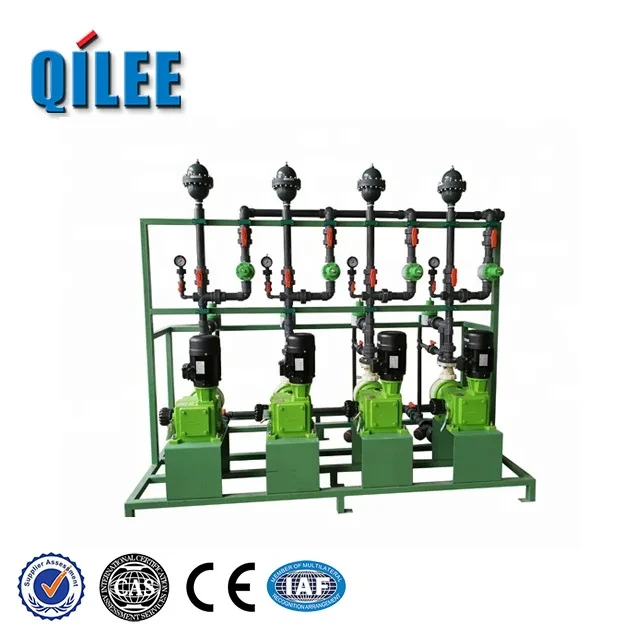
    The QWDS Polymer dosing system provides reliable automatic micro-dosing of PAC, PAM and other chemicals for coagulation, pH control and sludge dewatering, minimizing chemical waste and stabilizing treatment performance. Compact, modular cabinet designs with selectable screw or diaphragm metering pumps, built‑in back‑pressure and safety valves, filters and cleaning pipelines, plus DCS connectivity, deliver accurate, low‑maintenance operation and easy on-site integration. Shipped in standard export carton packing with typical lead times of 3–20 days, the QWDS Polymer dosing system pairs rugged, configurable components with fast delivery for dependable industrial wastewater dosing.

    1620183233g0e
    1620183233oxz

    Here are five four-word subtitle options, each reflecting a different perspective:

    The QWDS Polymer dosing system is an automatic powder micro-dosing unit for PAC/PAM and other additives, offering precise metering with selectable screw or diaphragm pumps and modular configurations (2/4/6 pump sets, 1000–2000 LPH) to support coagulation, pH control and sludge dewatering. It delivers value through online monitoring (pH, residual chlorine, DO, suspended solids, sludge concentration), automatic pump switching and DCS integration to optimize chemical usage, reduce waste and ensure consistent flocculation performance. Built‑in safety and maintenance features — backpressure and safety valves, filters, diaphragm pressure gauges, cleaning pipelines and compact, serviceable frames — provide stable operation, easy scalability and configurable dosing for PAC, PAM, activated carbon or lime emulsion.

    Automated Micro-Dosing for Wastewater 

    The QWDS Polymer dosing system is an automatic powder micro-dosing solution for wastewater treatment that precisely feeds PAC, PAM and other chemicals for regulation, coagulation and sludge dewatering. Equipped with screw or diaphragm metering pumps, back-pressure and safety valves, filters and cleaning pipelines, it supports online monitoring of pH, residual chlorine, DO and suspended solids while enabling automatic pump switching and dosing based on total flow and process concentration. Available in multiple modular models with pump capacities up to 2000 L/h per set and DCS connectivity, the system ensures stable, safe and customizable chemical addition for a wide range of industrial water processes.


    ◎ Precision Chemical Dosing 

    ◎ Adaptive Pump Switching

    ◎ Integrated Safety Controls

    16201832330io
    1620183233rje

    Precise Dosing, Superior Clarification

    Built by a team with decades of water-treatment expertise, the QWDS Polymer dosing system for PAC/PAM blends precision micro-dosing mechanics and durable materials to deliver low-maintenance, long-life performance. It automates powdered coagulant and polymer metering with adjustable pulse dosing, anti-clog agitation, self-clean cycles and remote monitoring to ensure consistent flocculation, reduced chemical consumption and stable effluent quality. Compact, energy-efficient and service-friendly, the system features modular feeders, PLC control and safety interlocks to simplify installation, scaling and regulatory compliance in municipal and industrial wastewater applications.

    Material introduction

    The QWDS Polymer dosing system is built from corrosion‑resistant materials, typically featuring a stainless steel (304/316) or coated carbon‑steel frame with powder‑contact tanks, hoppers and piping lined or molded from HDPE/PP to protect PAC/PAM from contamination and moisture. Critical wetted components such as screw pumps or diaphragm metering pumps are made from stainless steel and engineering alloys with PTFE/EPDM seals, while valves, filters and diaphragm pressure gauges use stainless or chemical‑resistant plastics to ensure durability. These material choices provide broad chemical compatibility with acids, alkalis, coagulants and flocculants, simplify cleaning and maintenance, and support reliable automated dosing and DCS integration.


    ◎ material introduction 1 

    ◎ material introduction 2

    ◎ material introduction 3

    1620183233lpr

    FAQ

    1
    What is an Auto Powder Micro-Dosing System for Wastewater (PAC/PAM) and what does it do?
    An Auto Powder Micro-Dosing System is a mechanized feeder and control package designed to meter small, precise amounts of powdered chemicals such as Powdered Activated Carbon (PAC) and dry Polyacrylamide (PAM) into wastewater processes. Its function is to deliver repeatable, low-rate dosing for tasks like adsorbing micropollutants (PAC), improving solids capture and dewatering (PAM), or supporting coagulation/flocculation. Typical components include a weatherproof hopper, anti-bridging devices, metering screw or vibratory feeder, PLC or controller for proportional dosing, and discharge/nozzle hardware.
    2
    In which wastewater treatment scenarios is this system most commonly used?
    Typical application scenarios include: municipal and industrial tertiary treatment for micropollutant and taste/odor control using PAC; improvement of flocculation and sludge dewatering in primary and secondary clarifiers with PAM; treating landfill leachate, textile, pharmaceutical or chemical effluents where small, continuous doses of powder are needed; stormwater and runoff treatment where low, metered chemical addition is preferred; and pilot or sidestream dosing trials where precise low-dose control is required.
    3
    How do I operate and control dosing to achieve consistent results?
    Operation generally involves programming the controller for either time-based or flow-proportional dosing (linked to a flow meter or plant PLC) and calibrating the metering device to deliver a target mass per unit time. Start by establishing required dose (e.g., mg PAC/L or mg PAM/L) from jar tests or design criteria, measure plant flow, and set feed rate accordingly. Verify actual delivered mass by collecting and weighing output over a fixed interval, then adjust the feeder calibration factor in the controller. Use gradual ramping and monitoring of process indicators (turbidity, sludge solids, dewatering cake, effluent COD/BOD) to fine-tune setpoints.
    4
    Are PAC and PAM both dosed the same way? Any special preparation required?
    No — they have different handling and activation needs. PAC can often be dosed dry directly into a wet well, mixer or dosing point and then mixed into the stream. PAM, especially polymer powders, commonly requires hydration to form an effective solution: either pre-hydrate in a polymer make-up tank or use a specialized hydrated polymer dosing module. If dosing dry PAM, ensure the polymer grade is suitable for dry feed and that downstream mixing is adequate to prevent poor floc formation. Always follow vendor recommendations for concentration, hydration time, and shear-sensitive handling of PAM.
    5
    What routine maintenance and housekeeping are required to keep the system reliable?
    Key maintenance tasks include: keep hopper dry and sealed to prevent caking and moisture ingress; inspect and clean feed screws or vibratory pans to remove build-up; check anti-bridging devices (agitators, vibrators) and replace worn parts; verify and recalibrate weight or volumetric metering periodically; replace filters and seals; ensure dosing lines and nozzles are clear; maintain PLC and sensors (flow meter, level probes) and backups; and periodically inspect dust control and PPE supplies. Maintain a log of calibrations and consumable part changes. Regular maintenance prevents inconsistent dosing from bridging or mechanical wear.
    6
    What safety, environmental, and troubleshooting considerations should I be aware of?
    Safety: use appropriate PPE (dust masks/respirators, gloves, eye protection) when handling powders; control dust with local extraction and sealed hoppers; be aware that some dry PAM grades contain residual acrylamide monomer — avoid skin contact and follow MSDS guidance. Environmental: avoid over-dosing which can increase sludge production or carryover of PAC into effluent; manage residuals and spent wash water per regulations. Troubleshooting: common issues—intermittent dosing caused by powder bridging, high humidity, worn feed screws, or incorrect controller calibration; sudden drift in feed rates often points to mechanical wear or clogging; poor process performance may indicate improper hydration of PAM or incorrect PAC dose/point-of-entry. For each issue, isolate mechanical causes first, verify calibration, then re-evaluate chemical type and dosing location.
    Tell Us More About Your Project !
    If you have any questions about water treatment systems, please feel free to contact QILEE.
      Stable equipment
      Mature technology
      Automated operation
      Simple operation

    Do You Have any Questions? Welcome to Leave Us a Message.

    Related Products
    no data
    Contact Us

    Tel: +86 13370035529

    Business What's App: +86 13636655908

    E-mail: qilee@qileegroup.com

    Add: No. 351 Wenqu Road, Fengxian District, Shanghai

    Your trusted Water Treatment System Partner
    no data
    Copyright © 2026 Shanghai QILEE Environmental Protection Equipment Co., Ltd | Sitemap
    Customer service
    detect