loading
CAF Cavitation Air Flotation Industrial Oil-Water Treatment 1
CAF Cavitation Air Flotation Industrial Oil-Water Treatment 2
CAF Cavitation Air Flotation Industrial Oil-Water Treatment 3
CAF Cavitation Air Flotation Industrial Oil-Water Treatment 4
CAF Cavitation Air Flotation Industrial Oil-Water Treatment 5
CAF Cavitation Air Flotation Industrial Oil-Water Treatment 6
CAF Cavitation Air Flotation Industrial Oil-Water Treatment 1
CAF Cavitation Air Flotation Industrial Oil-Water Treatment 2
CAF Cavitation Air Flotation Industrial Oil-Water Treatment 3
CAF Cavitation Air Flotation Industrial Oil-Water Treatment 4
CAF Cavitation Air Flotation Industrial Oil-Water Treatment 5
CAF Cavitation Air Flotation Industrial Oil-Water Treatment 6

CAF Cavitation Air Flotation Industrial Oil-Water Treatment

In a busy plant at dawn, CAF Cavitation Air Flotation sends a ballet of tiny bubbles across oily ponds, lifting slick film like soft mist. Cavitation and air float work hand in hand to pull oil from water, leaving clear flow you can reuse or safely release. Fast, green, and cost-wise, CAF turns dirty waste into clean calm — the smart heart of any modern treatment line.

5.0
brand name:
QILEE
Shipping:
Support Sea freight
Payments:
L/C,D/A,D/P,T/T,Western Union,MoneyGram,OA
Lead Time:
1-1(sets):60(days),>1(sets):To be negotiated(days)
Place of Origin:
China
design customization

    oops...!

    no product data.

    Go to homepage
    Total power(kw)
    0.55
    Scum skimmer(kw)
    0.18
    Aerator(kw)
    0.37
    Tank depth(m)
    1.1
    Tank width(m)
    0.55
    Tank length(m)
    1.4
    Treatment flow(m3/h)
    1
    Processing Type
    desalination
    Power(W)
    1 kW
    Product name
    cavitation air flotation
    Voltage
    220 V, 380 V
    weight (kg)
    100
    productivity
    500L/Hour
    warranty
    1 Year
    place of origin
    Shanghai, China

    Compact Robust Efficient Separation 

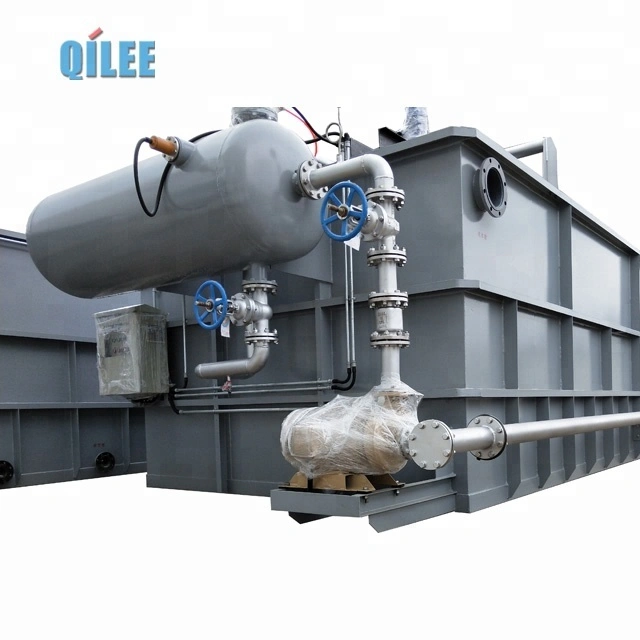
    CAF Cavitation Air Flotation delivers efficient oily wastewater separation using Dissolved Air Flotation principles to remove grease, jelly and suspended solids while cutting operating costs and chemical demand. Its compact, maintenance-free layout — stainless-steel aerator, integrated skimmer and modular tank shapes — saves floor space and eliminates bulky pumps, compressors and pressure vessels for simple, reliable operation. Available in multiple models with high-quality construction and standard export carton packing for protected delivery, it offers a cost-effective, scalable solution with a sleek industrial style tailored to petrochemical, food and paper industry needs.

    1620183233g0e
    1620183233oxz

    Efficient Cavitation Oil Separation

    The CAF cavitation air flotation unit applies Dissolved Air Flotation principles with a high‑speed aerator, perforated stainless steel impeller and submerged aeration ports to produce 30–100 μm micro‑bubbles that attach to and lift grease, jelly and suspended solids for rapid oil‑water separation. Structurally compact and maintenance‑free, the system eliminates the need for circulating pumps, compressors and pressure vessels, uses low total power and a skimming device to transfer floated solids to a scum tank, thereby reducing footprint, operating costs and capital investment. Offered in multiple flow models for industries such as petrochemical, oilfield, dairy, meatpacking and pulp & paper, it delivers simple operation, easy installation and economical, reliable treatment of oily wastewater.

    Cavitation Air Flotation Separation 

    The CAF cavitation air flotation system provides high-quality industrial oil-water separation and effective removal of grease, jelly, and suspended solids. Combining the principles of Dissolved Air Flotation with a specially designed bulk gas impeller and high-speed aerator, it generates 30–100 µm micro-bubbles without circulating pumps, air compressors, or pressure vessels. Compact, maintenance-free and cost-efficient, the CAF unit saves space and operating expenses while treating oily wastewater from petrochemical, oil extraction, meatpacking, dairy, and pulp and paper industries.


    ◎ Compact Low-Maintenance Design 

    ◎ High Precision Microbubbles

    ◎ Versatile Economical Treatment

    16201832330io
    1620183233rje

    Rapid High-Purity Oil Separation

    Built by a specialist R&D team, the CAF Cavitation Air Flotation Industrial Oil-Water Treatment merges advanced cavitation physics with Dissolved Air Flotation to achieve superior oil-water separation and enhanced contaminant release. It efficiently removes emulsified oils, fine suspended solids and dissolved organics using high-efficiency micro-bubble generation, compact modular units, automated controls and low energy consumption for fast clarification and minimal sludge. Key features and advantages include corrosion-resistant construction, easy maintenance, scalable footprint, rapid startup, and real-time monitoring for stable performance, lower operating costs and regulatory compliance.

    Material introduction

    The CAF Cavitation Air Flotation system, built on the principles of Dissolved Air Flotation, uses corrosion-resistant stainless steel for the bulk air impeller and flotation tank to withstand oily and abrasive waste streams. High-strength alloy housings and precision electric motors ensure durable aerator performance, while wear-resistant polymer skimmers, seals, and gaskets minimize fouling and simplify maintenance. Chemical-resistant coatings and standardized fasteners complete the material package for easy installation, long service life, and reduced lifecycle costs.


    ◎ Corrosion-Resistant Construction 

    ◎ High-Durability Components

    ◎ Sealed Chemical Compatibility

    1620183233lpr

    FAQ

    1
    What is CAF Cavitation Air Flotation and how does it remove oil from industrial wastewater?
    CAF (Cavitation Air Flotation) combines hydrodynamic cavitation and dissolved/gas flotation to generate very fine micro- and nanobubbles that attach to oil droplets and suspended solids. The bubbles increase buoyancy so contaminants rapidly rise to the surface and form a compact float layer that can be mechanically or automatically skimmed off. Cavitation also promotes coalescence and partial break-up of emulsions, improving separation speed and efficiency compared with conventional flotation.
    2
    What kinds of industrial wastewater and oils can CAF treat effectively?
    CAF is suitable for a wide range of oily wastewaters: petroleum and refinery effluents, metalworking and machining coolants, produced water, food-processing and vegetable/animal oil wastes, paint and coating rinses, and many industrial emulsions. It handles free, dispersed and lightly emulsified oils plus high suspended solids streams, though heavily stabilized emulsions or extremely fine dissolved organics may require upstream chemical conditioning or coalescers.
    3
    What effluent quality and removal rates can I expect from a CAF system?
    Typical oil removal efficiencies range from 80–99% depending on feed concentration, emulsion stability and pre-treatment; many installations achieve single-digit mg/L oil in the treated effluent when properly operated. Hydraulic retention times are short (often minutes), and treatment capacity scales by flow rate and skid size. Exact performance depends on influent characteristics, available chemical dosing, and system configuration—pilot testing is recommended for guaranteed numbers.
    4
    How is a CAF unit operated and what maintenance does it require?
    Operation requires controlling feed flow, cavitation pressure, air dosing (if applicable) and, where needed, coagulant or demulsifier dosing. Routine maintenance includes checking cavitation generators/venturis, pumps and air compressors, skimmer mechanisms, and periodic removal or dewatering of floated sludge/oil. Many systems are automated with level and flow controls; scheduled inspections and simple component replacements keep performance consistent.
    5
    How can a CAF system be integrated into an existing wastewater treatment line and what are installation considerations?
    CAF units are typically modular and skid-mounted for straightforward integration as a primary or polishing stage. They can be installed upstream of biological treatment or after primary settling depending on objectives; space, power, inlet/outlet piping and chemical dosing lines must be planned. Evaluate upstream screening/settling needs, expected peak flows, and available utilities (power and compressed air) to size and site the unit correctly.
    6
    What happens to the separated oil and sludge, and how do I manage disposal or recovery?
    The separated float (oil and compacted solids) is skimmed into a collection trough or tank for further dewatering, oil recovery or disposal. Recovered oil can sometimes be recycled or sold if sufficiently uncontaminated; concentrated sludge typically requires dewatering and disposal per local hazardous-waste regulations. Proper handling, storage and record-keeping ensure regulatory compliance and maximize any potential for oil recovery.
    Tell Us More About Your Project !
    If you have any questions about water treatment systems, please feel free to contact QILEE.
      Stable equipment
      Mature technology
      Automated operation
      Simple operation

    Do You Have any Questions? Welcome to Leave Us a Message.

    Related Products
    no data
    Contact Us

    Tel: +86 13370035529

    Business What's App: +86 13636655908

    E-mail: qilee@qileegroup.com

    Add: No. 351 Wenqu Road, Fengxian District, Shanghai

    Your trusted Water Treatment System Partner
    no data
    Copyright © 2026 Shanghai QILEE Environmental Protection Equipment Co., Ltd | Sitemap
    Customer service
    detect