


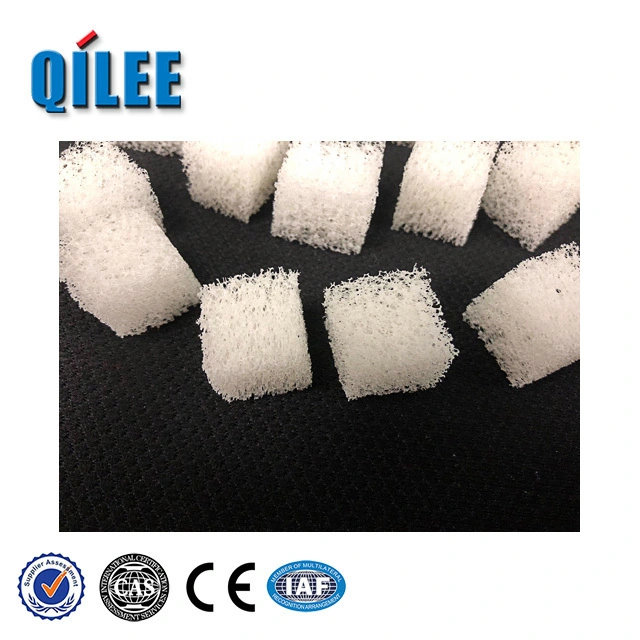
MBBR Polyurethane Biofilter Media K1 K3 K5
MBBR Polyurethane Biofilter Media K1 K3 K5 are durable polyurethane carrier pieces used in moving bed biofilm reactors. They offer very high surface area and open structure for biofilm growth, strong mechanical strength, long service life, and stable movement in the tank. The K1, K3 and K5 types are different sizes/densities so you can match them to flow, load and tank depth for efficient nitrification, denitrification and organic removal.
Usage scenarios (about 3 sentences):
They are used in municipal and small-town wastewater plants for secondary treatment and to improve nitrification and BOD/COD removal. They work well in industrial wastewater systems (food & beverage, dairy, brewery, textile, pharmaceutical, etc.) to cut organics and ammonia and help meet discharge limits. They are also popular in aquaculture and recirculating systems, aquariums, decentralized/onsite treatment and retrofit upgrades where added capacity or better treatment is needed without building larger tanks.
Efficient Durable Lightweight Prepackaged
MBBR polyurethane K1/K3/K5 biofilter media enhances treatment efficiency and reduces sludge return for Sewage Treatment Equipment by promoting rapid biofilm growth and high contaminant degradation. Manufactured as hydrophilic porous polyurethane pellets (10 ± 1 mm after expansion) with >2000 m2/m3 specific surface area, 98% voidage and ~12.5 kg/m3 dry density, it ensures fast microbial attachment, excellent BOD/COD/NH3 removal and a service life beyond 10 years. Packaged in standard export cartons with 3–20 day delivery windows and easy retrofit compatibility, this wear‑resistant media lowers energy and maintenance costs while simplifying installation and handling.
High Surface Area Media
The MBBR polyurethane biofilter media (K1, K3, K5) is a hydrophilic porous gel carrier with a unique wall structure, >2000 m2/m3 specific surface area, ~98% voidage and high elasticity that promotes durable microbial attachment and a service life beyond 10 years. In Sewage Treatment Equipment it functions as a fluidized aerobic carrier where rapid biofilm formation and mass transfer enable high nitrification and BOD/COD oxidation rates while reducing fan energy and sludge return. With wide pH and temperature tolerance, easy integration into MBBR systems, and high biological attachment density, the media delivers efficient contaminant removal, lower operating costs and stable, low‑maintenance performance for municipal and industrial wastewater treatment.
Versatile MBBR Carrier Options
The K1/K3/K5 MBBR polyurethane biofilter media is a hydrophilic porous PPC carrier with a unique wall structure that provides a very high specific surface area (>2000 m2/m3), excellent elasticity, and long service life to support aerobic biofilm growth. Kept fluidized by aeration, the carriers promote rapid microbial attachment and efficient pollutant removal with high nitrification and BOD/COD oxidation capacities while reducing sludge return and fan energy consumption. Suitable for MBBR systems, municipal and industrial wastewater treatment, and integrated Sewage Treatment Equipment, these carriers work across a wide pH and temperature range and last more than 10 years.
◎ product nicety 1
◎ product nicety 2
◎ product nicety 3
Efficient Durable Biofilm Media
Developed under a rigorous manufacturing process and decades of expertise, MBBR Polyurethane Biofilter Media K1 K3 K5 delivers a consistent carrier structure and high surface area to support robust biofilm growth for Sewage Treatment Equipment. Its lightweight, chemically resistant polyurethane composition and optimized geometry ensure low clogging, high oxygen transfer, and easy retrofitting into existing systems, suitable for municipal and industrial applications. Key features include high specific surface area, durable elastic matrix, excellent mechanical stability, and modular sizes (K1, K3, K5) that offer improved nitrification, reduced footprint, energy savings, and long service life.
Material introduction
Made from a polyurethane-based porous gel and polymer composite (PPC), the MBBR K1/K3/K5 media provides a hydrophilic, elastic carrier material that promotes rapid microorganism attachment and robust biofilm formation. Its unique wall structure, >2000 m2/m3 specific surface area and ~98% voidage ensure excellent mass transfer, high porosity and enhanced wear resistance for long service life in Sewage Treatment Equipment. Lightweight yet durable with low aeration energy needs, this carrier supports high nitrification and BOD/COD oxidation efficiencies while minimizing sludge return.
◎ Product overview
◎ material introduction 2
◎ K1 — Hydrophilic Elastic Porous
FAQ
 Stable equipment
 Mature technology
 Automated operation
 Simple operation
Do You Have any Questions? Welcome to Leave Us a Message.
Tel: +86 13370035529
Business What's App: +86 13636655908
E-mail: qilee@qileegroup.com
Add: No. 351 Wenqu Road, Fengxian District, Shanghai