
loading
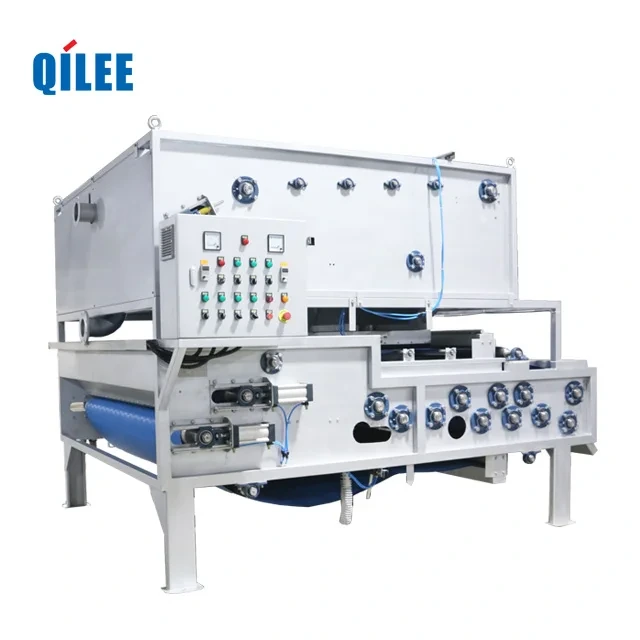
Automatic Continuous Double-Belt Filter Press for Wastewater 1
Automatic Continuous Double-Belt Filter Press for Wastewater 2
Automatic Continuous Double-Belt Filter Press for Wastewater 3
Automatic Continuous Double-Belt Filter Press for Wastewater 4
Automatic Continuous Double-Belt Filter Press for Wastewater 5
Automatic Continuous Double-Belt Filter Press for Wastewater 6
Automatic Continuous Double-Belt Filter Press for Wastewater 1
Automatic Continuous Double-Belt Filter Press for Wastewater 2
Automatic Continuous Double-Belt Filter Press for Wastewater 3
Automatic Continuous Double-Belt Filter Press for Wastewater 4
Automatic Continuous Double-Belt Filter Press for Wastewater 5
Automatic Continuous Double-Belt Filter Press for Wastewater 6

Automatic Continuous Double-Belt Filter Press for Wastewater

Automatic Continuous Double-Belt Filter Press for Wastewater

This machine is a continuous dewatering device that squeezes sludge between two moving filter belts to separate water from solids. It runs automatically, with steady pressure and adjustable speed, giving stable, low-moisture cake and clear filtrate. The design saves space and labor, and works well for sticky or high-solid sludge that is hard to dewater with simple centrifuges or single-belt presses. Key benefits are high throughput, low operating cost, easy operation, and reduced disposal volume and transport cost. Maintenance is simple: routine belt checks, periodic washing, and timely replacement of wear parts keep it running reliably.

Usage scenarios:

- Municipal wastewater plants use it to dewater sewage sludge before landfilling or composting, cutting volume and disposal cost.

- Food, chemical, and textile factories apply it to treat process sludge and recover water for reuse.

- Mines and metal-processing sites employ it for tailings and slurry dewatering to improve solids handling and support dry stacking or further processing.

5.0
brand name:
QILEE
Shipping:
Support Sea freight
Payments:
L/C,D/A,D/P,T/T,Western Union,MoneyGram,OA
Lead Time:
1-1(sets):30(days),>1(sets):To be negotiated(days)
Place of Origin:
China
design customization

    oops...!

    no product data.

    Go to homepage
    Base Dimension L1*H1(mm)
    5900*2600
    Reference Weight(kg)
    5600
    Powder Consumption(kw)
    4250
    Water Content's Rate(%)
    62~85
    Inlet Consistency(%)
    0.4~0.8
    Dried Sludge(kg/hr)
    380~750
    Treating Capacity(m3/hr)
    95~125
    Belt Width(mm)
    3000
    weight
    5600
    condition
    New
    automatic grade
    Automatic
    Dimensions(mm)
    7200*3650*3550
    dimension(l*w*h)
    7200*3650*3550
    Power
    4250
    Product name
    Workable Belt Filter Press
    Voltage
    220V/380V
    warranty
    1 Year
    place of origin
    China

    Continuous Automated Efficient Dewatering 

    The QTE3 sludge dewatering machine delivers continuous, energy-efficient double-belt dewatering with low cake moisture and quiet, safety-monitored operation to cut disposal costs and maximize uptime. Built from SUS304 stainless steel with imported Swiss filter cloth, automatic belt alignment and a compact double-belt layout, it ensures durable, low‑maintenance performance and easy installation. Standard export carton packing, modular/low-profile styling and robust industrial quality guarantee secure shipping, fast onsite assembly and long service life.

    1620183233g0e
    1620183233oxz

    Continuous Automated Double-Belt Dewatering

    The QTE3 sludge dewatering machine is an automatic continuous double-belt filter press built from SUS304 stainless steel with imported Swiss filter cloth, an air-chamber automatic belt deviation correction and a double-belt structure for stable, low-noise operation. Designed for wastewater and industrial slurry treatment, it delivers high-efficiency sludge dewatering with low cake moisture, low energy consumption and flexible operation while providing built-in washing and filtrate collection to minimize maintenance and operating costs. Its compact, modular layout—with safety monitoring, automatic stop devices and lower collecting trays—ensures easy integration, reliable continuous performance and suitability for municipal and industrial applications.

    Automatic Continuous Sludge Dewatering 

    The QTE3 sludge dewatering machine is an automatic continuous double-belt filter press built from SUS304 stainless steel with Swiss-imported filter cloth, an air-chamber automatic belt deviation correction device, and an integrated safety monitoring system to ensure stable, rust-resistant operation. It delivers high-efficiency sludge/water separation for municipal and industrial wastewater, food and beverage, and livestock applications while consuming low energy, operating at low revolutions with noise ≤75 dB(A), and producing low-moisture filter cakes with minimal maintenance. Available in multiple belt widths and capacities, the system supports auxiliary equipment such as sludge pumps, polymer dosing and washing pumps for flexible on-site configuration and reliable continuous operation.


    ◎ product nicety 1 

    ◎ product nicety 2

    ◎ The air‑chamber automatic belt deviation correction keeps the belts accurately aligned while integrated safety monitoring ensures stable, low‑noise, and energy‑efficient continuous operation. This automated system simplifies maintenance and can be scaled to different model sizes to meet varying processing demands. Note

    16201832330io
    1620183233rje

    Continuous High Efficiency Dewatering

    Born from decades of wastewater engineering and rigorous R&D, the QTE3 sludge dewatering machine embodies proven manufacturing quality and a brand commitment to durable, long-life equipment. As an automatic continuous double-belt filter press for wastewater, it delivers high-throughput continuous dewatering with PLC-controlled belt tension and cake-thickness management, low residual moisture and energy-efficient, unattended operation. Its compact footprint, corrosion-resistant belts and frames, quick-change wear parts and modular controls reduce maintenance and operating costs while helping facilities meet stringent discharge and sludge-handling standards.

    Material introduction

    The QTE3 sludge dewatering machine is constructed with high-strength stainless steel (SUS304) structural components for excellent corrosion resistance and long service life in demanding wastewater environments. It features Swiss-imported filter cloth for superior filtration performance and durability, combined with wear-resistant belts and precision drive rollers for stable continuous operation. Auxiliary parts such as the air-chamber automatic deviation correction device, sealed collecting trays and treated finishes are made from corrosion-proof materials to reduce maintenance and ensure safe, low-noise performance.


    ◎ SUS304 Stainless Structure 

    ◎ Reinforced Wear Components

    ◎ Corrosion Resistant Auxiliary

    1620183233lpr

    FAQ

    1
    What is an Automatic Continuous Double-Belt Filter Press and how does it work in wastewater treatment?
    An Automatic Continuous Double-Belt Filter Press is a continuous mechanical dewatering device that squeezes sludge between two porous, moving belts and a series of rollers to remove water. Sludge is chemically conditioned (if needed), fed between the belts, and then dewatered through gravity drainage and progressive mechanical compression zones. Automation manages feed rate, belt speed, pressure and chemical dosing so the system runs continuously with minimal operator intervention.
    2
    Which types of wastewater and sludge are suitable for this equipment?
    It is well suited for a wide range of sludges including municipal activated sludge and primary sludge, industrial sludges from food & beverage, pulp & paper, textiles, metalworking, mining, and chemical processes. Best results are achieved with sludges that respond to polymer conditioning or that have particulate solids; extremely fibrous or very sticky sludges may need pretreatment or alternative equipment.
    3
    In what application scenarios does the double-belt filter press provide the most benefit?
    Typical scenarios include high-volume continuous dewatering requirements (e.g., municipal sewage plants, industrial process lines), situations demanding low labor and automated operation, facilities where odor control and reduced sludge transport costs are priorities, and sites that need compact, continuous operation integrated into a larger treatment train (after thickening or chemical conditioning). It’s especially valuable where consistent cake dryness and reliable throughput are needed.
    4
    What performance and operational outcomes can I expect (throughput, cake dryness, automation)?
    Performance varies with sludge characteristics and conditioning. Continuous double-belt systems are designed for high throughput and typically deliver dewatered cake solids commonly in the range of ~25–45% dry solids for many municipal and industrial sludges; some industrial sludges can reach higher solids under optimized conditions. Automated controls regulate belt speed, tension, and dosing to maintain steady feed and stable cake quality, and allow 24/7 operation with remote monitoring and alarm functions.
    5
    What are the site, utilities and integration requirements for installation?
    You’ll need level, accessible floor area with adequate structural support for the machine footprint and sludge handling conveyors. Utilities typically include electrical power for drives and controls, polymer storage and dosing systems (if required), a wash water supply and drain, and space for sludge feed and cake discharge conveyors/trucks. The unit integrates well upstream of sludge thickening/conditioning and downstream to belt conveyors, screw presses, or cake processing; planning for routine belt cleaning and chemical storage is important.
    6
    What routine maintenance and common troubleshooting should operators expect?
    Routine maintenance includes belt inspection and replacement schedules, roller and bearing lubrication, polymer dosing system checks, belt washing system upkeep, and calibration of sensors and controls. Common issues are uneven cake formation (usually fixed by adjusting conditioning or feed distribution), belt tracking problems (corrected by tensioning and alignment), and reduced cake dryness (often solved by tuning belt speed, pressure or polymer dose). The automatic control system typically provides diagnostics and alarms to speed troubleshooting.
    Tell Us More About Your Project !
    If you have any questions about water treatment systems, please feel free to contact QILEE.
      Stable equipment
      Mature technology
      Automated operation
      Simple operation

    Do You Have any Questions? Welcome to Leave Us a Message.

    Related Products
    no data
    Contact Us

    Tel: +86 13370035529

    Business What's App: +86 13636655908

    E-mail: qilee@qileegroup.com

    Add: No. 351 Wenqu Road, Fengxian District, Shanghai

    Your trusted Water Treatment System Partner
    no data
    Copyright © 2026 Shanghai QILEE Environmental Protection Equipment Co., Ltd | Sitemap
    Customer service
    detect