


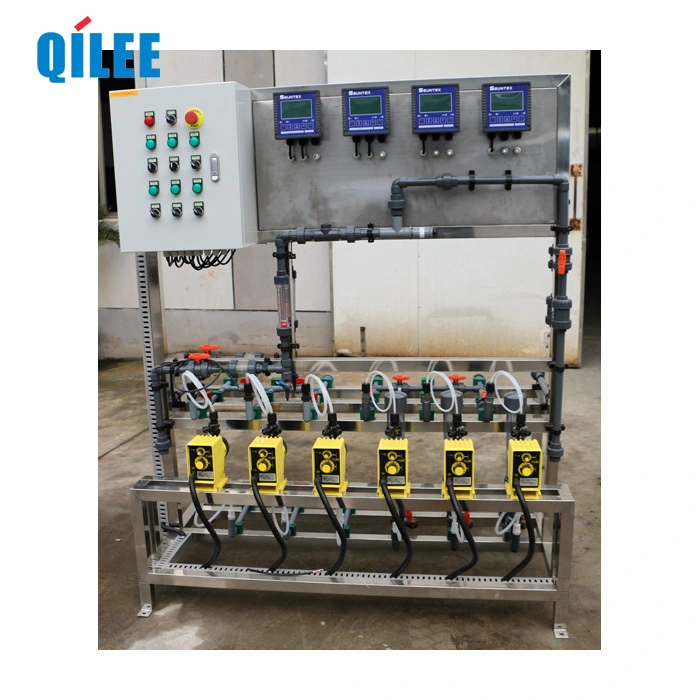
China Automatic Polymer Powder Dosing System for Wastewater
Short article:
The China Automatic Polymer Powder Dosing System for Wastewater is an automated device that stores, feeds, and accurately meters polymer powder (such as PAM) into wastewater and sludge processes. It combines sealed hoppers, screw or vibrating feeders, mixers, and PLC control for dust-free, repeatable dosing and easy integration with existing treatment lines. The system improves flocculation, speeds solids–liquid separation, reduces chemical waste and labor, and supports remote monitoring and stable operation in continuous processes.
Usage scenarios (about 3 sentences):
Municipal wastewater treatment plants use it for sludge conditioning and dewatering to improve belt press or centrifuge performance and reduce sludge volume. Industrial facilities—textile, paper, food, mining, chemical and power plants—use it to clarify process effluent, remove suspended solids, and meet discharge standards. Mobile or decentralized sites (construction, temporary treatment, emergency response) deploy compact dosing units for on-site flocculation and rapid sediment removal.
Precise Automated Dust-Free Performance
The QWDS Polymer dosing system delivers precise, automatic chemical dosing and online monitoring of pH, DO and suspended solids to stabilize coagulation and sludge dewatering while minimizing chemical waste and operator intervention. Built as a compact, modular skid with options for imported screw or diaphragm metering pumps, back-pressure and safety valves, filters and cleaning pipelines, it offers industrial-grade quality and reliable performance. Ships in standard export carton packing with 3–20 day delivery and can link to on-site DCS for automatic, flow‑matched dosing of PAC, PAM and other reagents.
Accurate Automated Powder Dosing
The QWDS Polymer dosing system is an automatic chemical powder dosing unit engineered for coagulation, regulation and sludge dewatering in wastewater treatment, providing precise addition of PAC, PAM, acids/alkalis and other reagents with integrated online monitoring of pH, residual chlorine, DO and suspended solids. Its modular structure offers selectable screw or diaphragm metering pumps in multiple configurations (up to six pump sets), standard safety items (back pressure and safety valves, filters, diaphragm pressure gauges, cleaning pipelines) and DCS connectivity, delivering stable operation, reduced chemical waste and improved process control. Automatic pump switching, programmable dosing matched to total flow and process concentration, and easy scalability and maintenance make the system flexible for diverse sites and enhance sludge dewatering efficiency.
Automated Polymer Dosing Solution
The QWDS Polymer dosing system is an automatic chemical powder dosing solution for wastewater treatment, providing precise addition of reagents such as PAC, PAM, acids/alkalis, carbon sources and demulsifiers for processes like regulation, coagulation and sludge dewatering. It supports online monitoring of pH, residual chlorine, DO, suspended solids and sludge concentration, can link with on-site DCS to match dosage by flow and concentration, and uses selectable screw or diaphragm metering pumps with safety components including back-pressure and safety valves, filters, diaphragm pressure gauges and cleaning pipelines. Available in multiple models with pump capacities up to 2000 LPH per set and configurations up to six pump sets, the system enables automatic pump switching and reliable, stable dosing for industrial and municipal applications.
◎ product nicety 1
◎ product nicety 2
◎ product nicety 3
Precise Automated Efficient Dosing
Developed by a leading Chinese water-treatment manufacturer with decades of R&D, the QWDS Polymer dosing system is an automatic polymer powder dosing solution for wastewater that pairs a precision screw feeder, sealed mixing chamber, and anti-bridging agitation for consistent feed and rapid hydration. It provides continuous, programmable dry-polymer dosing, PLC and remote-monitoring compatibility, accurate low-dose control and rapid flocculant activation to improve sludge dewatering, reduce chemical consumption and minimize downtime. Key features and advantages include modular, corrosion‑resistant construction for easy maintenance, self‑cleaning and anti‑clog mechanisms, energy‑efficient drives, adjustable dosing range with high repeatability, and compliance with international wastewater standards, delivering lower operating costs and reliable long‑term performance.
Material introduction
The QWDS Polymer dosing system is built with chemical-resistant 316L stainless steel for wetted components, high-density polypropylene/PVDF or PE for tanks and piping, and a robust coated steel frame for structural support. Metering units use screw or diaphragm pumps with PTFE, ceramic, or stainless steel wetted parts and imported-brand seals to resist acids, alkalis, PAC, PAM and other polymer flocculants. Standard accessories — back-pressure and safety valves, filters, PTFE-lined diaphragm pressure gauges and cleaning pipelines — are selected for compatibility and long-term stability in wastewater dosing applications.
◎ Stainless‑Steel Frame Model
◎ Chemical‑Grade Tank Variant
◎ PTFE‑Lined Wetted‑Parts Series
FAQ
 Stable equipment
 Mature technology
 Automated operation
 Simple operation
Do You Have any Questions? Welcome to Leave Us a Message.
Tel: +86 13370035529
Business What's App: +86 13636655908
E-mail: qilee@qileegroup.com
Add: No. 351 Wenqu Road, Fengxian District, Shanghai