
loading
Pool/Chlorine/Hydroponic/Aquarium Dosing System pH Control 1
Pool/Chlorine/Hydroponic/Aquarium Dosing System pH Control 2
Pool/Chlorine/Hydroponic/Aquarium Dosing System pH Control 3
Pool/Chlorine/Hydroponic/Aquarium Dosing System pH Control 4
Pool/Chlorine/Hydroponic/Aquarium Dosing System pH Control 5
Pool/Chlorine/Hydroponic/Aquarium Dosing System pH Control 6
Pool/Chlorine/Hydroponic/Aquarium Dosing System pH Control 1
Pool/Chlorine/Hydroponic/Aquarium Dosing System pH Control 2
Pool/Chlorine/Hydroponic/Aquarium Dosing System pH Control 3
Pool/Chlorine/Hydroponic/Aquarium Dosing System pH Control 4
Pool/Chlorine/Hydroponic/Aquarium Dosing System pH Control 5
Pool/Chlorine/Hydroponic/Aquarium Dosing System pH Control 6

Pool/Chlorine/Hydroponic/Aquarium Dosing System pH Control

Imagine stepping out at dawn to a mirror-smooth pool, a lush hydroponic rack, and a crystal-clear aquarium—each quietly cared for by a smart pH dosing system that works like a patient gardener. Tiny, timed doses of chlorine or nutrients, guided by live sensors, keep water perfectly balanced so fish thrive, plants glow green, and swimmers enjoy safe, sparkling water. No fuss—just professional-grade precision and peace of mind, so your water stays beautiful and healthy every day.

5.0
brand name:
QILEE
Shipping:
Support Sea freight
Payments:
L/C,D/A,D/P,T/T,Western Union,MoneyGram,OA
Lead Time:
1-1(sets):30(days),>1(sets):To be negotiated(days)
Place of Origin:
China
design customization

    oops...!

    no product data.

    Go to homepage
    size
    2000*1000*1700
    Suitable for medicament
    12
    Electronic control
    0,1
    Maximum number of instruments
    4
    Pump type
    Diaphragm pump
    Pump qty
    4sets
    Maximum flow rate
    1000LPH
    Processing Type
    desalination
    Power(W)
    2 kW
    Product name
    Aquarium Dosing System
    Voltage
    220 V, 380 V
    weight (kg)
    100
    productivity
    500L/Hour
    warranty
    1 Year
    place of origin
    Shanghai, China

    Here are five 4-word subtitle options: 

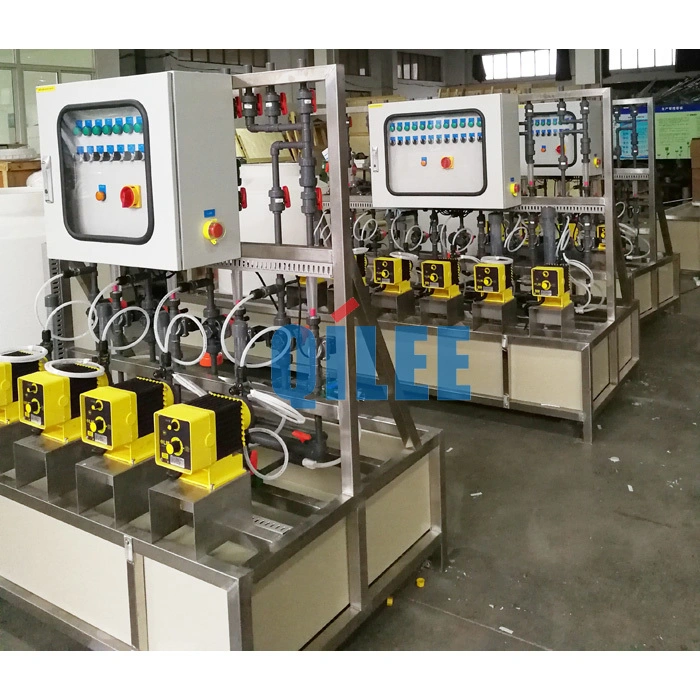
    For precise pH control and automated chemical dosing in pools, hydroponics and aquariums, the QWDS Polymer dosing system delivers reliable, scalable metering of acid/alkali, chlorine, PAC, PAM and nutrients to maintain water quality and cut manual labor. Housed in compact, modular cabinets with selectable screw or diaphragm metering pumps, plus back‑pressure and safety valves, filters and cleaning pipelines, it provides durable, high‑accuracy performance matched to process volume and concentration. Shipped in standard export carton packing with model options sized for different flows and easy DCS integration, it enables straightforward installation, secure operation and typical delivery within 3–20 days.

    1620183233g0e
    1620183233oxz

    Here are three four-word subtitle options:

    The QWDS Polymer dosing system is a modular pool/chlorine/hydroponic/aquarium pH control solution featuring selectable imported screw or diaphragm metering pumps (up to 2000 LPH per pump), multiple pump-set configurations, and built-in safety and DCS-compatible control interfaces. Designed to automatically dose acids, alkalis, PAC, PAM, carbon sources, nutrients, reducing agents and demulsifiers, it provides online monitoring of pH, residual chlorine, DO, suspended solids and sludge concentration while enabling automatic pump switching and dosage matching to total flow and process concentration. Its compact, rugged structure includes back-pressure and safety valves, filters, diaphragm pressure gauges and cleaning pipelines as standard, delivering stable, scalable and safe dosing performance for regulation, coagulation and sludge dewatering applications.

    Automated pH Control System 

    QWDS Polymer dosing system delivers automated chemical dosing and pH control for pools, hydroponic setups, aquariums and wastewater processes, handling acids, alkalis, PAC, PAM, carbon sources and nutrients. It features selectable screw or diaphragm metering pumps, online sensors for pH, residual chlorine, DO and suspended solids, plus safety items like back-pressure and safety valves for reliable automatic pump switching. Available in dual- to six-pump models with up to 2000 L/H per pump, it supports coagulation, flocculation and sludge dewatering and can integrate with on-site DCS for flow- and concentration-based dosing.


    ◎ product nicety 1 

    ◎ product nicety 2

    ◎ product nicety 3

    16201832330io
    1620183233rje

    Accurate Automated pH Control

    Developed through years of water-treatment engineering and a commitment to safety and sustainability, the QWDS Polymer dosing system embodies the brand’s legacy of reliable, user-centered solutions for pool, chlorine, hydroponic, and aquarium pH control. It automates precise chemical dosing, continuous pH monitoring, and remote alerts to maintain optimal water chemistry while minimizing overuse of chemicals and manual intervention. Key features include corrosion-resistant materials, programmable dosing schedules, self-priming metering pumps, modular scalability and leak detection, delivering enhanced accuracy, reduced operating costs, and long-term durability.

    Material introduction

    The QWDS Polymer dosing system is built from chemical-resistant materials—304/316 stainless steel frames and enclosures, HDPE or polypropylene dosing tanks, and reinforced PVC/PP piping—engineered to handle acids, alkalis, PAC, PAM, activated carbon suspensions and lime emulsions. Metering components use imported screw or diaphragm pumps with PTFE/EPDM seals and ceramic or alloy wet ends, while valves, fittings and manifolds are chosen in polypropylene or PVDF for long-term corrosion resistance. Standard safety and control hardware includes back-pressure and safety valves, high-efficiency filters, diaphragm pressure gauges and cleaning pipelines, all compatible with online pH, chlorine and DO sensors and DCS integration.


    ◎ material introduction 1 

    ◎ material introduction 2

    ◎ material introduction 3

    1620183233lpr

    FAQ

    1
    What is a dosing system for pH control and how is it used in pools, chlorine systems, hydroponics, and aquariums?
    A dosing system automatically injects precise amounts of acid or alkaline solutions to keep water pH within a target range. In pools and chlorine systems it stabilizes pH to maintain sanitizer effectiveness and comfort. In hydroponics it keeps nutrient solution pH optimal for plant uptake. In aquariums it preserves a safe chemical environment for fish and corals. The system typically includes a pH probe/controller, a peristaltic or diaphragm dosing pump, chemical containers, and tubing.
    2
    How does the dosing controller decide how much chemical to add?
    The controller continuously reads the pH probe and compares the measured value to the setpoint and allowable deadband. When pH drifts outside the deadband, the controller triggers the pump for a calculated dose (fixed pulse, proportional, or PID control depending on the model) to correct the pH. Some systems also consider flow sensors, time-based limits, or totalizer feedback to avoid overdosing.
    3
    Which chemicals and concentrations are commonly used for pH adjustment in each application, and what safety precautions are needed?
    For lowering pH: muriatic acid (hydrochloric) or phosphoric acid are common in pools, while phosphoric or citric acids are used in hydroponics and aquaria (citric for gentler use). For raising pH: sodium carbonate (soda ash) or potassium hydroxide are used, with potassium compounds often preferred in hydroponics to avoid sodium buildup. Always use appropriate PPE (gloves, goggles), store chemicals in labeled containers, use chemical-resistant tubing and pump heads, install spill containment, and follow local regulations for handling and disposal.
    4
    How often should pH probes and dosing systems be calibrated and maintained?
    Calibrate pH probes at least monthly (or more frequently in harsh or heavily buffered systems) using two-point buffer solutions that bracket the expected pH range. Rinse and inspect probes weekly for fouling; clean per manufacturer instructions. Check pump tubing, check valves, and fittings monthly for wear or leaks, and replace per recommended service intervals (often 6–12 months). Verify system response by performing manual test doses periodically.
    5
    What are common installation and placement tips to ensure accurate pH control?
    Install the pH probe in a well-mixed sample point or bypass loop where representative water flows past the sensor (avoid dead zones, air pockets, and direct chemical injection points). Place the dosing injection point upstream of mixing features or an inline static mixer to ensure rapid dilution. Keep chemical containers below the injection point or use non-return valves to prevent backflow. Provide ventilation for acid/alkali tanks and route tubing to avoid kinks.
    6
    How do I prevent overdosing and what fail-safes should be included?
    Use a conservative deadband and time-limited dosing pulses or PID control to avoid large corrective doses. Include a maximum daily dose limit and a pump lockout if the probe reads implausible values or loses signal. Install non-return valves, secondary containment, and an alarm for probe failure, low chemical level, or leaks. Regularly log pH trends so you can spot drift or repeated corrections that indicate a plumbing or process problem rather than a dosing issue.
    Tell Us More About Your Project !
    If you have any questions about water treatment systems, please feel free to contact QILEE.
      Stable equipment
      Mature technology
      Automated operation
      Simple operation

    Do You Have any Questions? Welcome to Leave Us a Message.

    Related Products
    no data
    Contact Us

    Tel: +86 13370035529

    Business What's App: +86 13636655908

    E-mail: qilee@qileegroup.com

    Add: No. 351 Wenqu Road, Fengxian District, Shanghai

    Your trusted Water Treatment System Partner
    no data
    Copyright © 2026 Shanghai QILEE Environmental Protection Equipment Co., Ltd | Sitemap
    Customer service
    detect